
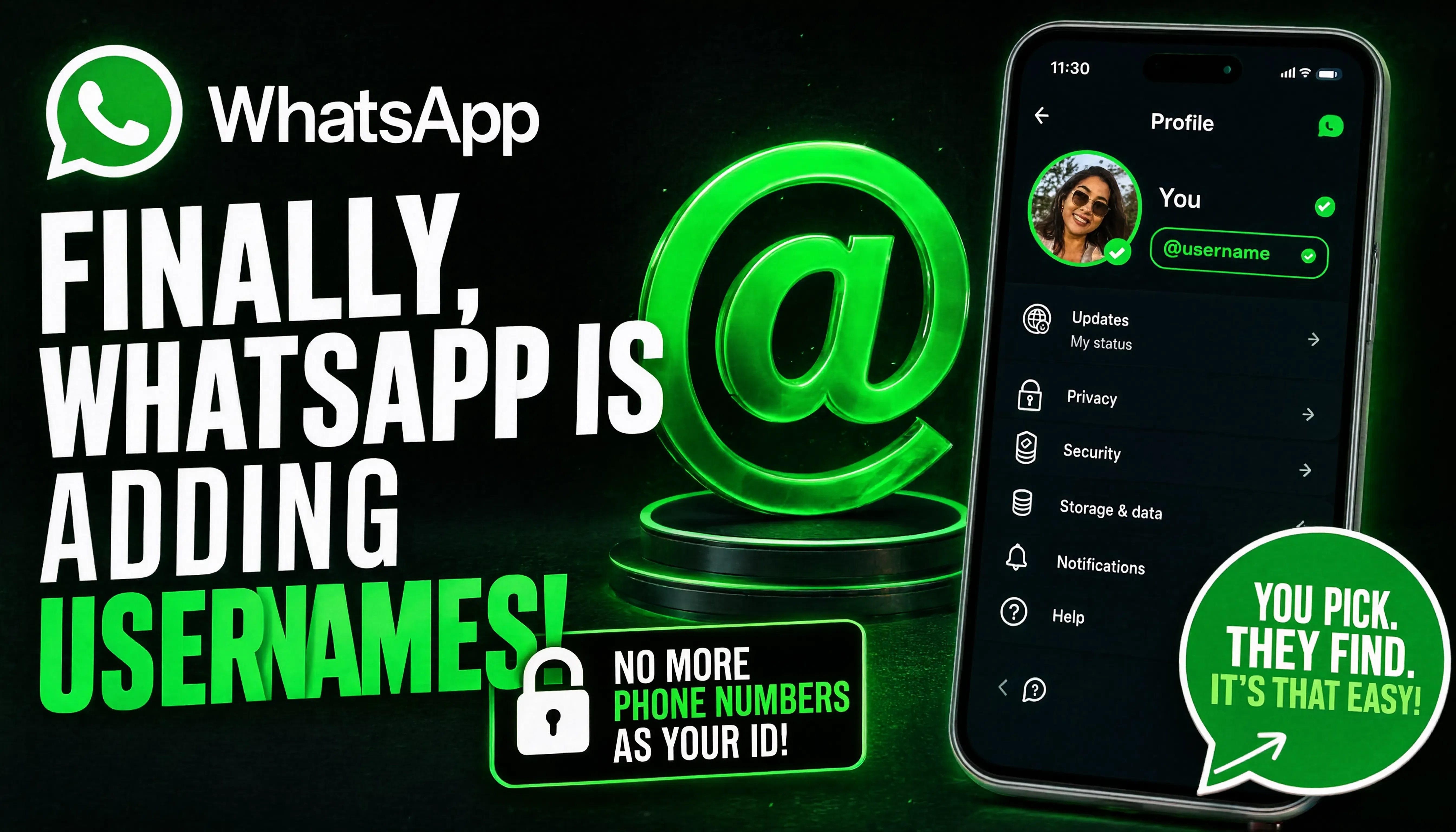
WhatsApp Usernames: A New Era for Private Messaging
For more than 15 years, WhatsApp has been built around one simple idea: your phone number is your identity. Every conversation, contact, and business interaction began with sharing a mobile number.
That is finally changing.
WhatsApp is rolling out usernames, allowing people to connect without exposing their personal phone numbers. The feature represents one of the biggest identity changes in the platform's history and brings WhatsApp closer to modern messaging platforms that prioritize both privacy and convenience.
The announcement has generated significant interest among users, businesses, creators, and privacy advocates. While WhatsApp has always focused on end-to-end encryption, usernames introduce an additional layer of privacy by letting users communicate through a unique public identifier instead of their phone number.
The move also reflects a broader trend in digital communication. More people want to connect online without immediately revealing personal contact details, especially when interacting with businesses, communities, online marketplaces, or people they have just met.
Interestingly, although this feature is new to WhatsApp, it has existed on other messaging platforms for years. We'll explore that history later in this article and compare WhatsApp's implementation with Telegram's pioneering approach.
What Are WhatsApp Usernames?
WhatsApp usernames allow users to create a unique identifier that others can use to contact them instead of their phone number.
Rather than saying:
"My number is +44..."
you'll simply be able to share something like:
@johnsmith
or
@rafenthic
This means users can begin conversations while keeping their phone numbers private.
According to WhatsApp, usernames are designed to become an alternative way of identifying people within the app while maintaining WhatsApp's existing security and end-to-end encryption.
Official WhatsApp information:
Why Is This Such a Significant Update?
For years, one of WhatsApp's biggest criticisms has been its dependence on phone numbers.
Although phone numbers make onboarding incredibly simple, they also create several challenges.
Users often hesitate to share personal numbers when:
- buying or selling online
- joining communities
- networking professionally
- contacting businesses
- speaking with people they don't know personally
Usernames solve this problem.
Instead of exposing sensitive contact information, users can simply share a public identifier.
This approach improves privacy while making communication more flexible.
How WhatsApp Usernames Work
Although the global rollout is still ongoing, WhatsApp has confirmed several important details.
The system is expected to work like this:
Choose a Unique Username
Each account can reserve a username that no one else can use.
Just like email addresses or social media handles, usernames must be unique across the platform.
Phone Numbers Stay Hidden
When someone starts a conversation using your username, they won't automatically see your phone number.
This creates an additional privacy layer, especially for people communicating with strangers.
Existing Chats Continue Normally
Nothing changes for your existing contacts.
Friends and family who already have your phone number saved will continue chatting exactly as before.
Usernames simply introduce another way to connect.
End-to-End Encryption Remains
Perhaps most importantly, WhatsApp has confirmed that usernames do not replace its security model.
Messages remain protected using WhatsApp's end-to-end encryption.
Only the method of identifying users changes.
Why Did WhatsApp Wait So Long?
This is one of the most interesting questions surrounding the announcement.
Unlike most messaging apps, WhatsApp built its entire ecosystem around phone numbers.
That approach offered several advantages:
- no usernames to remember
- no friend requests
- no account searches
- instant synchronization with your contacts
This simplicity helped WhatsApp become one of the world's most widely used messaging platforms.
However, digital communication has evolved significantly.
Today, users expect greater control over their online identities.
Platforms increasingly allow people to communicate without exposing personal information.
As privacy concerns have grown worldwide, username-based identities have become increasingly valuable.
WhatsApp's decision reflects this changing expectation.
Benefits of WhatsApp Usernames
Better Privacy
The biggest benefit is obvious.
Instead of sharing your phone number with every new person you meet online, you'll be able to share a username instead.
This reduces unnecessary exposure of personal information.
Easier Business Communication
Businesses often want customers to contact them without revealing employees' personal numbers.
Usernames provide a cleaner and more professional way to initiate conversations.
For companies investing in digital growth, this aligns well with broader branding strategies. If you're exploring how strong digital identity supports long-term business success, our guide on Corporate Branding Strategies for Long-Term Growth offers practical insights
Better Creator Experience
Creators, freelancers, consultants, educators, and influencers frequently share contact information publicly.
Instead of publishing a phone number, they'll now be able to share a memorable username.
This reduces spam while making communication more accessible.
Improved Online Safety
Many scams begin after someone's phone number becomes publicly available.
By allowing usernames instead, WhatsApp helps users limit unnecessary exposure.
While usernames won't eliminate scams entirely, they add another layer of protection.
What This Means for Businesses
Businesses increasingly rely on WhatsApp for customer support, sales, and relationship management.
Usernames can make interactions feel more professional while protecting personal contact details.
Combined with strong branding, SEO, and content marketing, this creates a more polished customer experience.
If you're looking to strengthen your digital presence beyond messaging, explore our digital marketing Services
WhatsApp's Broader Direction
Usernames are part of a larger evolution of WhatsApp.
Over the past few years, the platform has introduced:
- Communities
- Channels
- Multi-device support
- Passkeys
- Chat Lock
- Advanced Privacy settings
- AI integrations
- Improved business tools
Taken together, these updates show that WhatsApp is evolving from a simple messaging app into a broader communication platform.
Usernames fit naturally within that strategy by giving users more flexibility while preserving the simplicity that made WhatsApp successful in the first place.
The Evolution of Digital Identity in Messaging Apps
Today, using a username instead of a phone number feels natural. Whether you're joining a gaming community, connecting with a client, or messaging someone you've just met, sharing a unique username is often more comfortable than revealing your personal mobile number.
However, this wasn't always the standard.
In the early 2010s, most messaging applications relied almost entirely on phone numbers to identify users. This approach made account creation quick and simple, but it also meant that anyone you wanted to chat with had access to your personal contact number.
As messaging apps evolved, privacy expectations changed. Users wanted more control over who could see their phone number while still making it easy to connect with others.
One of the first major messaging platforms to address this challenge was Telegram.
Telegram Introduced Usernames in October 2014
On 23 October 2014, Telegram officially launched public usernames, giving users the ability to communicate without sharing their phone numbers.
The feature was introduced as part of Telegram version 2.1, alongside several other improvements, including temporary media viewing and enhanced privacy controls.
According to Telegram's announcement:
"You can now choose a username so people can contact you without knowing your phone number."
Source:
https://telegram.org/blog/usernames
Technology publication TechCrunch also covered the launch on the same day, highlighting usernames as one of Telegram's most important privacy-focused updates.
TechCrunch:
At the time, this was a significant step forward for messaging privacy.
Instead of saying:
"Here's my phone number."
Users could simply say:
"@username"
This reduced unnecessary exposure of personal information while making it easier to communicate online.
The Timing: Around the iPhone 6 Era
The launch also aligns with a memorable period in smartphone history.
Apple released the iPhone 6 on 19 September 2014.
Just over a month later, on 23 October 2014, Telegram introduced usernames.
For many long-time users, this explains why the feature feels like it has "always existed" on Telegram. It arrived during a period when messaging apps were rapidly evolving and smartphones were becoming the primary way people communicated online.
Why Telegram Introduced Usernames
Telegram's philosophy has always emphasized privacy and user control.
Although users still registered with a phone number, Telegram recognized that people didn't necessarily want to share that number with everyone they chatted with.
Usernames solved several problems at once.
Protecting Personal Information
Users could join groups, communities, or public discussions without exposing their personal contact details.
Easier Networking
Professionals, freelancers, creators, and businesses could simply share a username instead of distributing their personal phone number.
Public Profile Links
Telegram later expanded the feature by allowing users to create shareable profile links.
Initially available as:
telegram.me/username
these eventually became the now-familiar:
https://t.me/username
These links made it possible to start a conversation with someone directly from a website, email signature, social media profile, or QR code.
Today, millions of businesses and creators use these links as part of their digital presence.
WhatsApp Took a Different Path
While Telegram focused on adding flexibility, WhatsApp continued building around a much simpler principle:
Your phone number is your identity.
This philosophy offered several advantages.
- No usernames to remember.
- No searching for people by handle.
- Instant synchronization with your phone's contact list.
- Faster onboarding for new users.
This simplicity played a major role in WhatsApp becoming the world's most widely used messaging platform.
However, it also created a trade-off.
Anyone who wanted to message you typically needed your phone number.
As online commerce, creator communities, and digital networking grew, many users began looking for a more privacy-friendly way to connect.
Why WhatsApp Is Introducing Usernames Now
More than a decade after Telegram introduced usernames, the digital landscape has changed dramatically.
Several factors likely influenced WhatsApp's decision.
Growing Privacy Expectations
People today are far more conscious of how their personal information is shared online.
A phone number is no longer seen as something to give out freely, especially when interacting with strangers, online sellers, or public communities.
Usernames help reduce unnecessary exposure.
Business Communication
Millions of businesses use WhatsApp for customer support and sales.
A username provides a cleaner, more professional way for customers to initiate conversations without immediately accessing an employee's personal phone number.
This aligns with broader digital branding trends. A consistent online identity across websites, messaging apps, and social platforms strengthens customer trust. If you're interested in building a recognizable brand, our guide on Corporate Branding Strategies for Long-Term Growth explores this in more detail.
The Creator Economy
Content creators, educators, consultants, and freelancers increasingly rely on messaging apps to communicate with their audiences.
Sharing a username is more memorable, easier to promote, and generally safer than publishing a phone number.
Increased Competition
The messaging landscape has become more competitive than it was in 2014.
Platforms like Telegram, Signal, Discord, and others have demonstrated that users value flexible identity systems that balance accessibility with privacy.
While WhatsApp has its own design philosophy, introducing usernames reflects an acknowledgment of these changing expectations.
A 12-Year Gap Between Telegram and WhatsApp
Looking purely at the timeline:
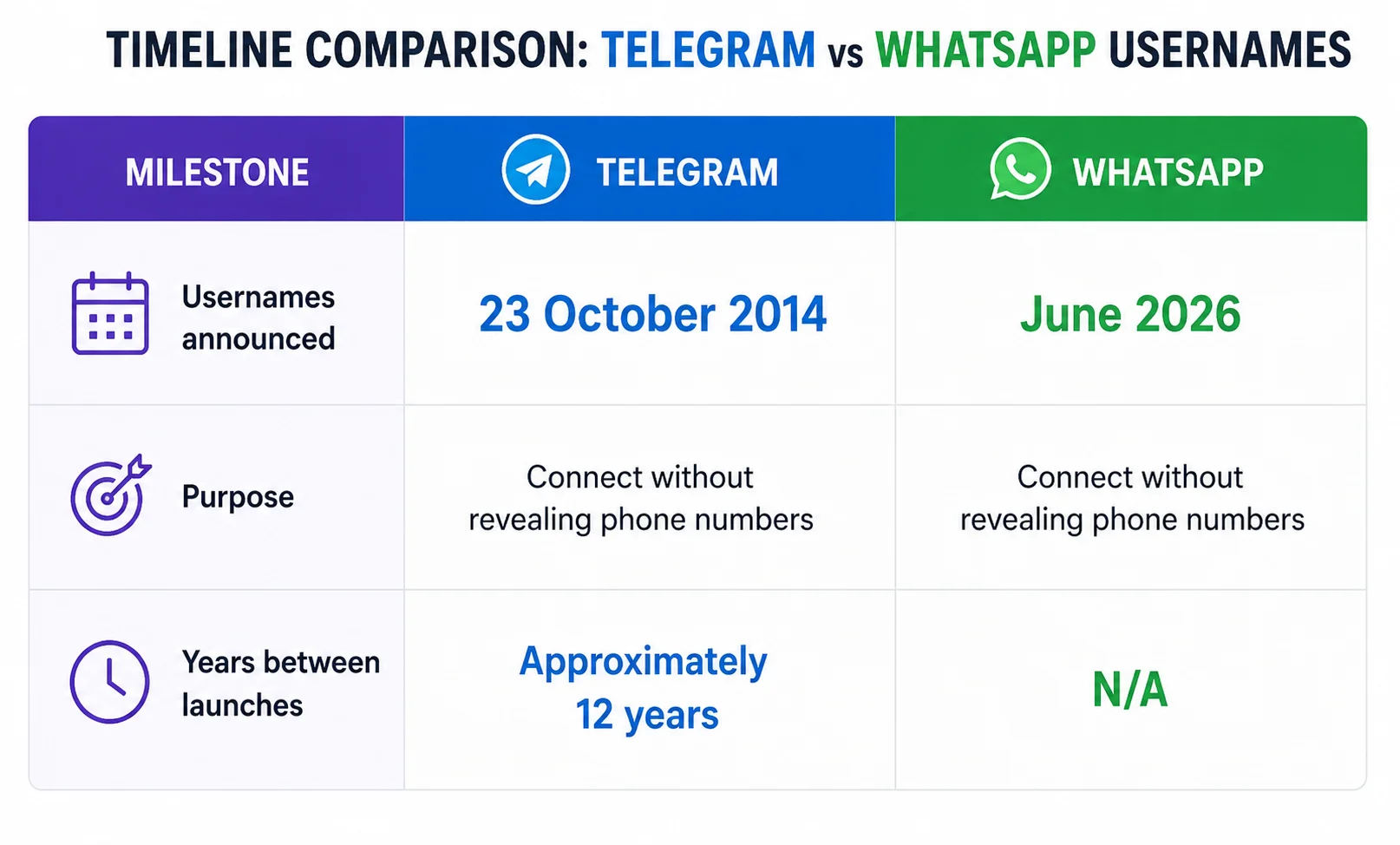
This doesn't necessarily mean WhatsApp copied Telegram's implementation. Technology companies often develop similar features independently as user expectations evolve.
However, from a historical perspective, it's clear that Telegram introduced the concept of username-based messaging identities years before WhatsApp began rolling out its own version.
That's an important distinction because it highlights how messaging priorities have shifted over the past decade. A feature once considered innovative has gradually become an expected part of modern communication.
Messaging Apps Continue to Learn From Each Other
The technology industry has a long history of platforms adopting ideas that users have already embraced elsewhere.
Examples include:
- Stories becoming popular across multiple social media platforms.
- Short-form video expanding beyond its original platforms.
- Channels and broadcast features appearing in various messaging apps.
- Username-based identities becoming increasingly common.
Rather than viewing these developments solely as competition, they often reflect a broader evolution in user expectations. When a feature consistently improves usability or privacy, it's common for multiple platforms to adopt their own version over time.
This pattern demonstrates how successful ideas spread across the industry while each platform adapts them to fit its own ecosystem and user experience.
WhatsApp Usernames vs. Telegram Usernames: What's the Difference?
Although both platforms now allow users to connect through usernames instead of sharing phone numbers, their implementations have some notable differences.
The table below summarizes the current approach of each platform.
What Both Platforms Have in Common
Despite their different histories, WhatsApp and Telegram now share several key advantages:
- Users can connect without immediately exchanging phone numbers.
- Usernames are unique to each account.
- Businesses and creators gain a more professional way to share contact information.
- Personal phone numbers remain better protected in many conversations.
Where Telegram Still Has an Edge
Telegram has spent more than a decade refining its username ecosystem.
Over the years, usernames have become deeply integrated into features such as:
- Public channels
- Large communities
- Bots
- Mini Apps
- Public profile links (
t.me/username) - Search by username
- QR code sharing
Because Telegram introduced usernames in October 2014, many third-party tools, businesses, and online communities have already built workflows around them.
Where WhatsApp Has the Advantage
WhatsApp's biggest strength has always been its enormous global user base.
With more than 2 billion monthly users, adding usernames could make privacy-focused messaging accessible to a much wider audience without requiring people to switch apps.
For many users, this means enjoying the convenience of usernames while staying on the messaging platform they already use every day.
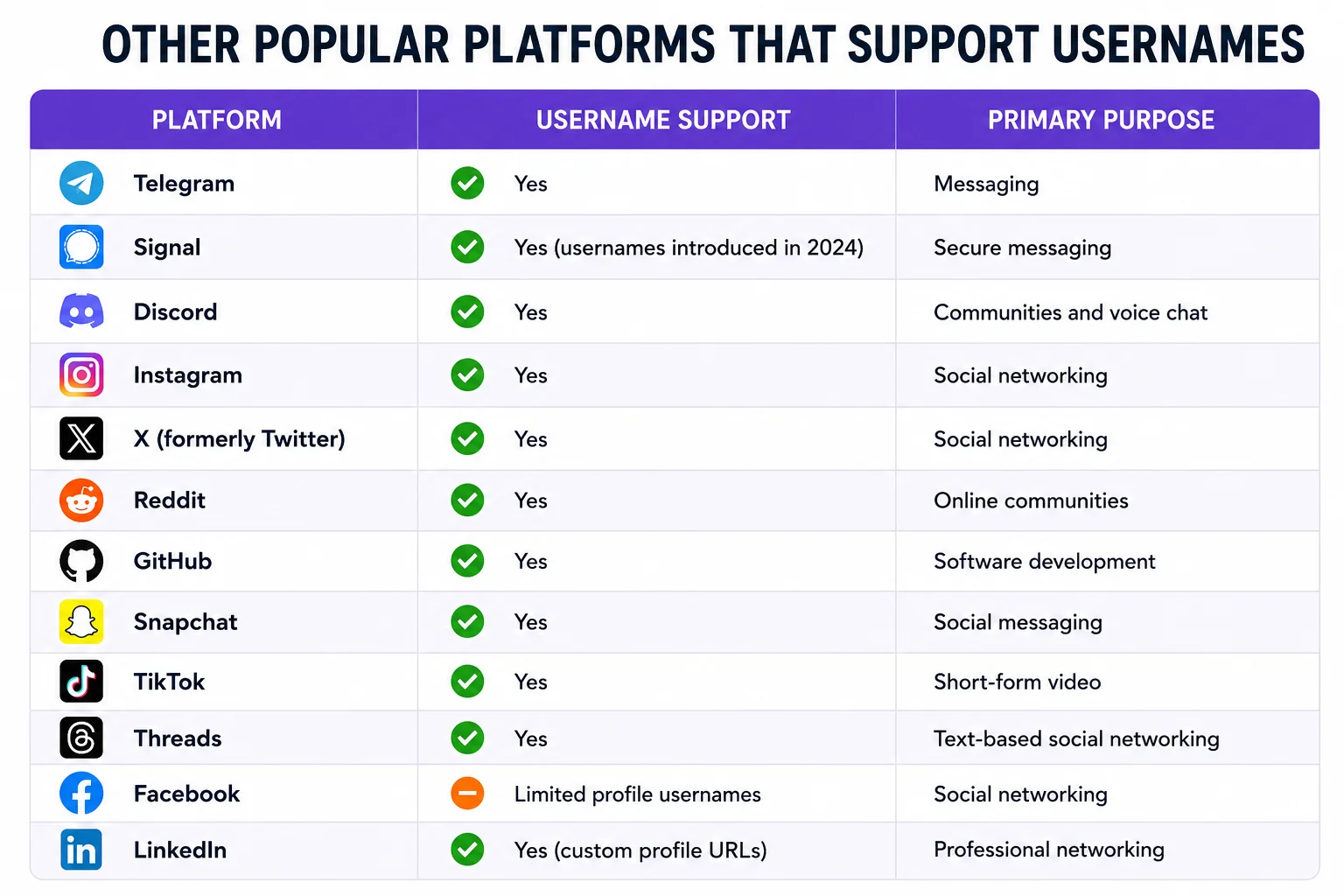
Other Popular Platforms That Support Usernames
Messaging apps are no longer the only services using username-based identities. Many digital platforms rely on unique usernames instead of phone numbers as the primary way users connect.
Here are some of the most widely used examples:

The widespread adoption of usernames reflects a broader shift in how people identify themselves online. Rather than sharing personal contact information, users increasingly prefer a unique, memorable identifier that can be used across websites, apps, and communities.
Why This Matters for Businesses
The introduction of usernames isn't just a convenience for individual users. It also has important implications for businesses, freelancers, agencies, and creators.
A More Professional Way to Connect
Instead of publishing a personal phone number on a website or social profile, businesses can share a recognizable username.
This creates a cleaner customer experience and reduces concerns about exposing private contact details.
Improved Brand Consistency
A consistent username across platforms strengthens brand recognition.
For example, if a business uses the same name on WhatsApp, Instagram, LinkedIn, and its website, customers can find and remember it more easily.
This is one reason branding and digital identity go hand in hand. If you're building a long-term online presence, our guide on Corporate Branding Strategies for Long-Term Growth explores practical strategies for creating a consistent brand across digital channels.
Better Marketing Opportunities
Usernames also simplify marketing materials.
Instead of printing a long international phone number on business cards, brochures, or advertisements, businesses can promote a short, memorable username.
What This Means for the Future of Messaging
The introduction of usernames signals a broader evolution in messaging platforms.
Over the past decade, users have increasingly prioritized:
- Privacy
- Simplicity
- Professional communication
- Cross-platform consistency
- Better control over personal information
Usernames support all of these goals while reducing the need to share sensitive contact details.
As messaging continues to evolve, identity will likely become more flexible, allowing users to choose when, how, and with whom they share personal information.
Frequently Asked Questions
Are WhatsApp usernames available to everyone?
WhatsApp is rolling out the feature gradually. Availability depends on your app version, region, and account. Users should keep WhatsApp updated to receive new features as they become available.
Will I still need a phone number?
Yes.
At the time of writing, WhatsApp accounts still require a phone number during registration. Usernames provide an additional way for others to contact you but do not replace the registration process.
Can people still see my phone number?
When someone starts a conversation using your username, WhatsApp is designed to protect your phone number. Existing contacts who already have your number will continue to communicate as usual.
Did Telegram introduce usernames before WhatsApp?
Yes.
Telegram officially introduced public usernames on 23 October 2014, allowing users to communicate without sharing their phone numbers.
WhatsApp announced its own username system in June 2026, approximately twelve years later.
Although the two platforms have implemented the feature differently, the historical timeline shows that Telegram introduced the concept much earlier.
Are usernames more secure than phone numbers?
Usernames improve privacy by reducing unnecessary exposure of personal phone numbers.
However, users should still follow good security practices, including enabling two-factor authentication, verifying contacts when appropriate, and avoiding suspicious links or requests.
Related Resources
If you're interested in digital platforms, branding, and online growth, you may also find these Rafenthic resources helpful:
- Instagram Auto Follow Back Feature Update
- Corporate Branding Strategies for Long-Term Growth
- How SEO Helps Skincare Brands Grow Online
- Adobe Acquires SEMrush: What It Means for SEO
- Explore Our Digital Marketing Services
- View Our Portfolio
- Contact Rafenthic
Authoritative Sources
For readers who want to explore the announcements and reporting in more detail, the following sources provide additional context:
- WhatsApp Official Help Center
- https://faq.whatsapp.com/
- Meta Newsroom
- https://about.fb.com/news/
- Telegram Blog: Usernames Announcement (23 October 2014)
- https://telegram.org/blog/usernames
- TechCrunch: Telegram Adds Usernames (23 October 2014)
- https://techcrunch.com/2014/10/23/secure-messaging-app-telegram-adds-usernames-and-snapchat-like-hold-to-view-for-media/
- The Verge (coverage of WhatsApp features)
- https://www.theverge.com/
Final Thoughts
WhatsApp introducing usernames marks one of the platform's most meaningful updates in years. By allowing people to connect without immediately revealing their phone numbers, the feature addresses a growing demand for privacy while making communication more flexible for individuals, businesses, and creators.
At the same time, this update is part of a broader industry trend rather than an isolated innovation. Telegram demonstrated the value of username-based messaging when it launched public usernames on 23 October 2014, and over the following decade, many other platforms adopted similar identity systems.
Today, usernames have become an expected part of the digital experience. WhatsApp's implementation brings this capability to one of the world's largest messaging communities, giving billions of users more control over how they connect while preserving the simplicity that has defined the platform since its launch.
Whether you're a casual user looking for greater privacy or a business aiming to build a more professional digital presence, WhatsApp usernames represent a practical step toward safer and more flexible online communication.